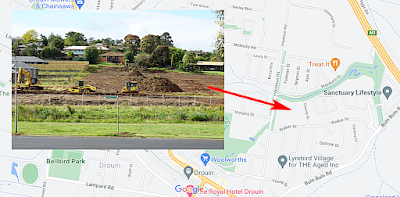
Tuesday, February 22, 2022

Do we NEED big homes?

There are obvious pros and cons for buying a large house. Some of the pros include; more space for a growing family, a larger nest egg for retirement, space for entertainment or maybe room for a business or office.

The obvious cons are; more expensive, higher utility costs, greater maintenance, more furnishing and decoration required, unnecessary or unused space and there is the tendency to collect and store more junk. Some owners of large homes have a false impression of success.

Large homes need a large footprint; they take up more land. This often leads to less yard area for kids to play and for adults to relax and less room for a garden.

Longwarry
 

Despite our house sizes falling a little in the last few years, Australia and the USA lead the world in big homes. LINK

The average floor size of an Australian home is 186.3m². The biggest Australian homes are being built in Victoria, 244.8m². With an average occupancy of a little over 2 people, that equates to more than 100m² per person – more than the total size of an average house in Ireland and The Netherlands!

Drouin
 

A quick check of a popular real estate website for ten new 3 and 4 'bedroom' homes in Warragul and Drouin gave an average of 241m².

In 2020, the Australian Bureau of Statistics released data that shows, “The average site area of new houses in Australian capital cities has decreased by 22% over the last 15 years”. LINK

Warragul

Many of our new developments of large homes on small blocks also have minimal nature strips. There is very little space for a canopy tree. The urban heat island effect generated from such designs results in increased energy costs and reduced health outcomes.

Is it time we designed for the amount of home we need and not for the amount we want?


Wednesday, January 26, 2022

The fics and the musks

This season, some of the Princes Way avenue of Ficifolias were beginning to flower in November. Now that most of the trees are in full bloom, the main gateway to our town is spectacular.

Sixty of these trees were planted by Drouin Primary School students in 1936 so they are now approaching 90 years of age. The trees are the inspiration for the annual Ficifolia Festival which began in 1989 and is held each February at the height of the blooming season.


The Ficifolia species is endemic to a small area of south-west WA but despite its restricted natural distribution, it is one of the most commonly planted trees in Australia.

In the mid to late 1800s, Ferdinand von Mueller described the species and named it Eucalyptus ficifolia. In 2009, DNA analyses placed the tree in the Corymbia genus and the species was renamed Corymbia ficifolia. Corymb = flat-topped flower cluster and ficfolia = fig-like leaf.

The Ficifolias in Princes Way are buzzing with bees and screeching with lorikeets and wattlebirds right now. There’s quite a show going on.

Musk Lorikeets are smaller than the more familiar Rainbow Lorikeet. They are just about all green with a bright red stripe through the eye and across the forehead. They are very nomadic as they chase the flowering eucalypts around the area.


Musks are very active feeders. They clamber through the foliage seeking the nectar and pollen from the freshest flowerheads, often hanging upside down to access the blossoms.


Like all our lorikeets and many other birds and mammals, Musk Lorikeets are reliant on tree hollows for nesting. Apparently, John Gould gave the name ‘musky parrakeet’ to the bird because of its peculiar musky odour (?).

Monday, January 3, 2022

Avoid, minimise or offset

 Guidelines for the removal, destruction or lopping of native vegetation were scrutinised in the Inquiry into ecosystem decline in Victoria that was tabled on 2nd December 2021.

DELWP noted in its submission to the Inquiry that native vegetation clearing regulations were reviewed in 2017 and changes adopted through the review process sought to increase protection of sensitive native vegetation, enhance the operation of the guidelines, and increase transparency.
 

However, despite these changes, DELWP noted that environmental data indicates that native vegetation coverage across Victoria has continued to decline.

(From the inquiry: “Victoria’s ecosystems are currently facing serious decline. Population growth and spread has put pressure on ecosystems, which has led to the degradation and loss of many native species and habitats.”)

Buln Buln Rd 30/10/2021

 The three-step approach (avoid, minimise, offset) was and still is the key policy in relation to the removal of native vegetation to achieve no net loss to biodiversity as a result of the removal, destruction or lopping of native vegetation.

(From the inquiry: “We found that there is room for improvement in the native vegetation regulatory framework and how offsetting arrangements are provided for under Commonwealth legislation.”)

The Avoid and Minimise approaches were retained by the Inquiry with a caution, but both still have the same proviso that they “Must provide appropriate evidence to show that no options exist to avoid native vegetation removal that will not undermine the objectives of the proposed use or development.”

(From the inquiry: “We find that many of the legislative tools available under
Victorian legislation are under utilised or poorly implemented, and that some legislative provisions are overly complex, overlapping, or outdated.”
)

Could it be that one of the main causes of biodiversity loss can be found here, and the reason native vegetation across Victoria has continued to decline is because this attitude and wording might provide a loophole?

(From the inquiry: “Finding 17: Offsetting arrangements provided for by the EPBC Act 1999 are contributing to ecosystem decline.”)

Hopetoun Rd 16/11/2021

What might change if this very negative wording were to be reversed to become “that no options exist to avoid native vegetation removal that will not undermine the objectives of environmental and biodiversity protection and care?”