Tuesday, October 25, 2016

Spotted Gums


The Spotted Gum, Corymbia maculata, is a popular amenity or street tree. The garden staff of the former Buln Buln Shire planted many of these stately trees in the streets and parks of Drouin and today we reap the benefits of their efforts and forethought.
 
An 'avenue' of Spotted Gums in Princes Way west
Indigenous to Australia, Spotted Gums grow naturally in open forests along the coastal strip from southern Queensland, down through NSW and just into Victoria.

The tree has an intermittent flowering period of several years. When they do burst into flower, the Spotted Gum becomes very popular with lorikeets and other honeyeaters, insects, bats, gliders and possums. Also, when they do flower, the casual observer may miss the event as they flower predominately in the crown.
The large fruit of Corymbia maculata
 Mature natural trees are sometimes used for sawn timber – furniture, flooring, and some construction so long as it above ground away from possible termite attack.

Not only a popular street or parkland tree, Spotted Gums are a favoured tree of bee keepers – the high pollen count is an advantage and generally, queens fed on Spotted Gum are vigorous and long-lived.
 
The striking trunk markings develop as thin outer bark flakes away.
Spotted Gums were formerly classified in the eucalyptus genus. In 1999, along with about 80 other species, they were transferred to the newly created corymbia family.

Sunday, October 16, 2016

What's Happening?


Dear Readers,

Please do not assume that the lack of blog posts here lately is in any way a sign of a paucity of progress. The opposite in fact is the case and any evidence of slackness only comes from yours truly and not our very active committee.

So, what indeed has been happening?

Our Drouin Tree Walks Booklet
The information for ten walks has been prepared and checked. The walks have been trialed by several members. Helen Timbury Design, (Helen on Facebook), has started the design work and gratefully, Drouin Bendigo Bank and the Baw Baw Shire have contributed funds toward the production. Further funding to complete this project is imminent and work on fine tuning some of the data is underway.


Gardivalia Tree Walks
As part of the Gardivalia Festival that is currently in progress, The Friends of Drouin’s Trees has conducted one walk to date. Twelve passionate souls braved some fairly miserable weather but we enjoyed some of Drouin’s magnificent trees, parks and wetlands. Poetry was read, trees were measured, history was related, policy explained, wildlife spotted, etc.

Two further walks are planned – Town Centre, Thursday 20th October, meet at the Drouin Railway Station car park at 11am, and McNeilly Wetlands, Friday 27th October, meet at McNeilly Wetlands at 9am. If you would like join in the fun, meet some of these passionate, (tragic?), tree people, or simply find out more, please email Judy, (thegablesatdcsidotnetdotau) or Peter, (heyfieldwaresatwidebanddotnetdotau).

Working Bees
Our group has the support of the Baw Baw Shire to conduct some ‘low level’ working bees around the town. Presently we are concentrating on simply tidying up some areas by picking up rubbish and pulling a few obvious weeds. Our list of sites continues to grow – just like some of the weeds!


On-Site Meetings
On several occasions we have met with gardens/environmental staff from Baw Baw Shire and tree removal contractors to discuss the treatment of some vulnerable trees. These discussions have given us the opportunity to provide an alternative view to the complete removal of some of our wonderful specimens. As a result, some diseased trees or ‘high-risk’ trees have been converted to habitat trees rather than be cut down. This involves pruning or trimming to remove dangerous branches and to stabilize the tree. In some cases the tree is girdled with a chainsaw to stop further growth and the process of chain sawing extra hollows into the remaining trunk is being conducted.

Recently, three large giants in Binbeal Rd were treated in this way. Though now no longer alive, these three giants are still contributing to the environment and at least one possum and one duck family are grateful for that! (Photos by Gippy Tree Services)


Asset Mapping
The many hundreds of trees that The Friends of Drouin’s Trees have suggested as being significant have been identified, measured and GPS located in order to be placed on a Baw Baw Shire list of assets. Being listed in this way will hopefully provide some level of protection and preservation in the future - single trees, lines of trees and ‘polygons’ of trees have been identified.

Many other tasks, large and small are in hand, being attended to or waiting time for completion. Hopefully this summary gives some idea of the work being done. I’m reminded of the Michael Caine quote, “Be like a duck, all serene on the surface, paddling like h… underneath”.


Friday, September 30, 2016

Drouin’s Oaks #1


In early times, much of western Europe was covered with dense oak forests.

Many old oak trees took on characteristics that were often the origins of myths and folklore and many splendid specimens were given anthropomorphic names in recognition of famous people or events.

Little wonder that early European arrivals to West Gippsland were keen to continue their long-held connections to this iconic tree species. In the streets and parks of Drouin to this day we reap the benefits of plantings of some magnificent oaks by early settlers to the district.


Oak Street in Drouin is named in honour of the old oak trees along the south west side of Oak Street Kindergarten. The trees are thought to have been planted early in the 1900s to provide shelter for the livestock in the sale yards which were located in this triangle of land. In the 1936 aerial photographs of Drouin these oaks look like they could have been about 20+ years old. These saleyards were the central yards for farmers around the district and livestock were walked into town by farmers from places like Drouin West. The close proximity to the train station meant that livestock could be freighted easily by rail.


Oak Street Kinder was established in 1964.  In Keith Pretty’s book, Buln Buln to Baw Baw, he says: “This Kindergarten has an almost unique ‘oldworld’ setting with its beautiful old oak trees which provide valuable learning experiences for the children. They learn from the acorns, the birds and the animals (possums) which are there because of the trees”. 


Many children, now adults, who attended the Kindergarten remember taking home pockets full of acorns! At least one family even has an oak tree grown from one of these acorns and it is most likely that the oak tree on the southeast side of the railway bridge could also be an offspring!


Today there are four remaining English oaks, Quercus robur, three in the Kindergarten grounds and one just to the west of the kinder boundary. They are 18-20m high with 20m wide canopies, providing wonderful shade cover for preschool children, the birds and the cars parked in the street in summer, and more than ample mulch for the kinder and JC Wells park in autumn. They are truly splendid specimens.


Perhaps in the future, some of Drouin’s magnificent oaks will be ‘honoured’ in the same way many of the European ancient trees are today.

(Thanks to Judy for this post)

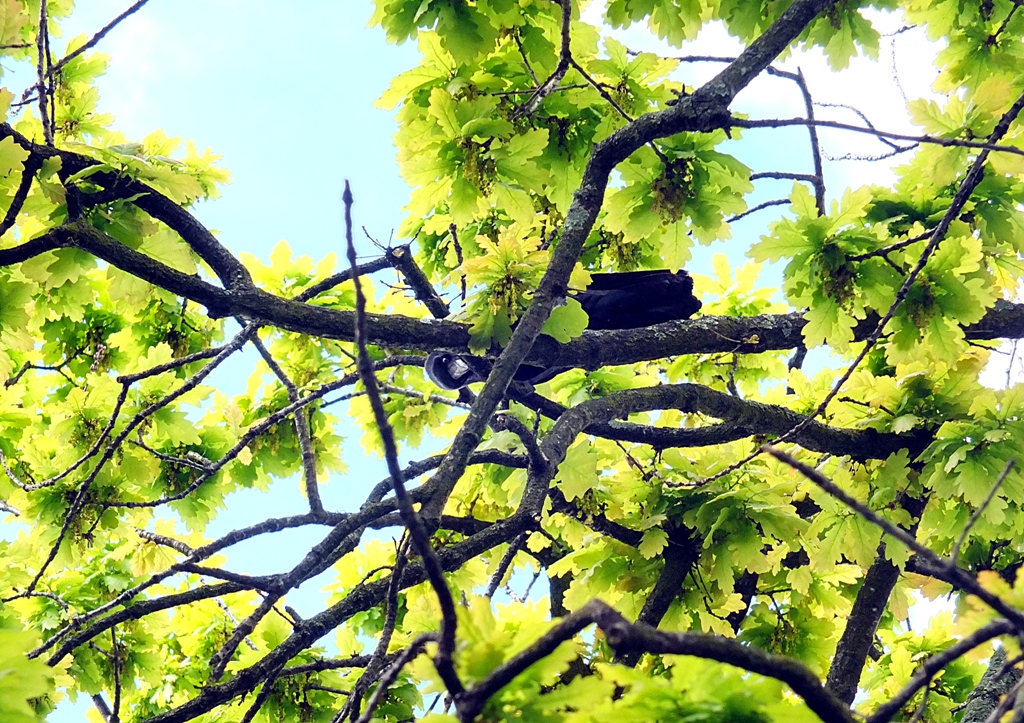
PS: Whilst the Pedunculate Oak is not considered highly as a habitat tree, some Little Ravens, (I think), and some Pied Currawongs were busy feeding on lichen on the branches in the canopy.