The calculations for determining the amount of carbon stored
within a tree are fraught with assumptions, estimates, margins of uncertainty, generalisations
…. But hey, this is a tree blog so let’s have a go!
All plants absorb carbon dioxide but trees do it best.
 |
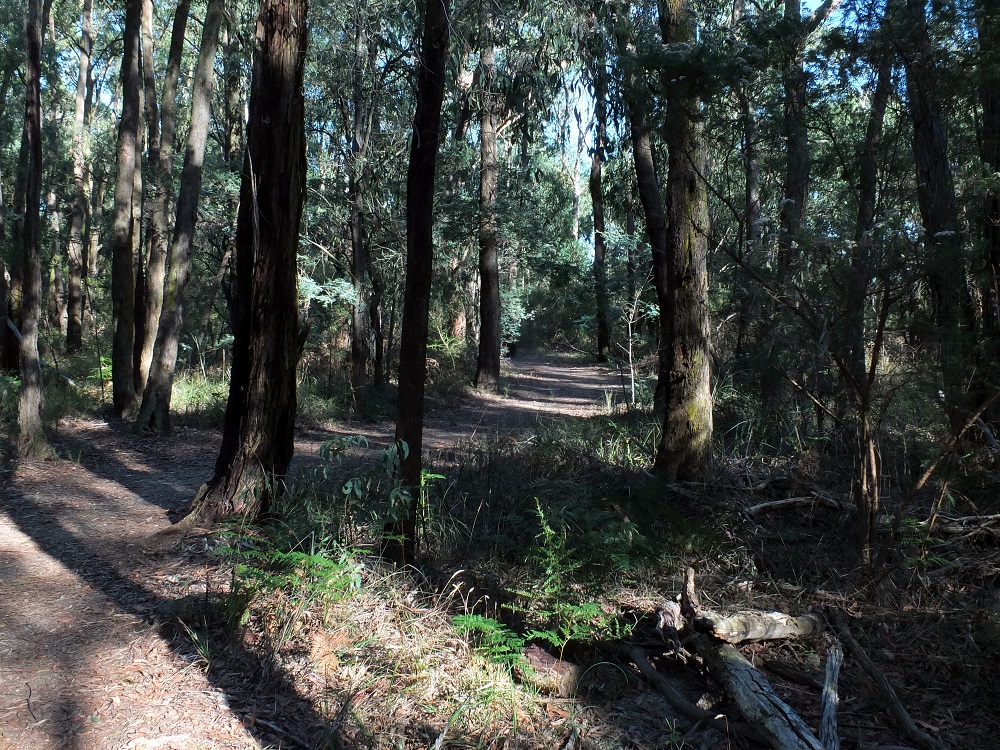
| Mountain Ash in Glen Nayook - columns of carbon |
Trees take in carbon dioxide and release oxygen while
cleaning the air we breathe and they do this, day in, day out. The process in
which they do this is called photosynthesis –
carbon
dioxide + water (and sunlight) = glucose (carbohydrate) + oxygen +
water(vapour).
Trees store carbon in their leaves, branches, trunks, bark
and roots.
If the wood in a tree is used for making timber products –
furniture, house frames, railway sleepers, etc – the carbon remains in the wood
for the life of the product.
If a tree or wood product is burnt or allowed to rot and
decay, the carbon is returned to the atmosphere.
Fast growing and long-lived tree species store the most
carbon but usually these two factors are mutually exclusive. In Australia, the
best species for carbon sequestration are the eucalypts and the acacias.
 |
| Blackwood in Mt Worth State Park |
Australian forests sequester about 57 million tonnes of
carbon dioxide each year, which sounds a lot but this accounts for barely 10%
of the greenhouse gasses released into the atmosphere – we need to plant many,
many more trees and even then it would only be part of the solution to global
warming.
So here goes – let’s try and work out how much carbon is
stored in the Bill Kraft Giant, a Mountain Grey Gum in Albert Rd Drouin. We can
then do a simple conversion to determine the quantity of carbon dioxide that
has been extracted from the atmosphere by this single tree.
 |
| Bill Kraft Mountain Grey Gum Albert Rd Drouin |
(The method used here has been taken from the website forest learning
which aims to serve school teachers and educators, children, and the public
with information on Australian forests and forest-based products, and provision
and access to forestry teaching resources.)
Circumference c from BBS tree register (note 1 below) c = 7m
Radius r
r = c ÷ 2π = 1.11m
Height h from BBS tree register h =
35m
Volume v from forest learning website (note 2 below) v = πr²h x 0.7854 = 106.4m³
Estimated green density ρ
ρ ~ 1000kg/m³
Mass of green tree above ground Mgreen Mgreen = vρ =
106400kg
= 106t
= 106t
Plus estimated 20% for root system Mgreen =
106 +
(0.2 x 10⁶) = 127t
(0.2 x 10⁶) = 127t
Dry mass of tree (approx. 65% of green mass) Mdry = 0.65 x 127 =
82.6t
Estimated mass of C (50% 0f dry mass) Cmass = 0.5 x
82.6
= 41.3t
= 41.3t
Estimate mass of carbon dioxide CO₂ (note 3 below) CO₂mass = 41.3 x 3.67
= 151.6t
= 151.6t
Notes
1 The Baw Baw Shire tree register is now available
on-line.
2 The coefficient 0.7854 in the volume formula is
provided to allow for trees not being exactly cylindrical, spaces between
branches, etc.
3 The coefficient 3.67 in the carbon dioxide calculation
is to account for the ratio of the molecular weights of carbon dioxide to
carbon.
Conservatively then, The Bill Kraft Giant in Albert Rd
Drouin has sequestered about 41 tonnes of carbon in its lifetime.
 |
| So valuable! |
These 41 tonnes of carbon represent 151 tonne of the greenhouse gas, carbon dioxide, that has
been removed from the atmosphere.